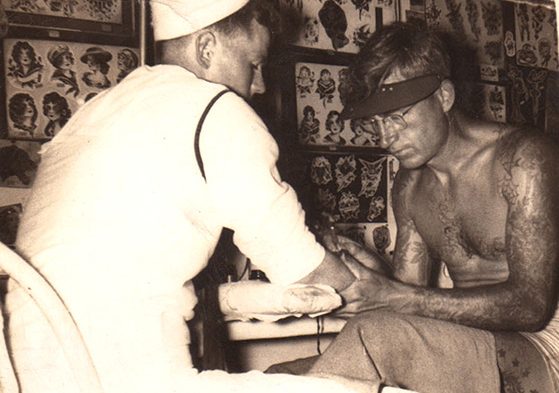
Paul Rogers: The Architect of American Traditional Tattooing
Franklin Paul Rogers (1905–1990), or simply Paul Rogers, is widely regarded as the "Father of American Tattooing", a title earned through sixty-one years of relentless dedication to the craft as an artist, mentor, and revolutionary machine builder. For anyone seeking a traditional tattoo in Berlin, understanding Rogers is essential; his technical innovations and cultural standards are the very foundation upon which artist like Mariano from Traditional Tattoo Berlin are built.
In the world of tattooing, some names represent a style, but Paul Rogers represents the standard. His life was a bridge between the rough-and-tumble era of traveling circuses and the sophisticated, technically precise discipline of modern traditional work. By mastering both the art of the skin and the mechanics of the "irons" that delivered it, Rogers ensured that the American heritage style would not just survive, but thrive for generations.
From the Cotton Mills to the Circus: The Early Years
Born Franklin Paul Rogers on September 9, 1905, in a cotton mill town in North Carolina, Paul’s early life was defined by hard labor. He began working in the mills at age thirteen, a period he later described as "nothing but hardship." However, his life took a permanent turn in 1926 when, at the age of 21, he received his first tattoo from Chet Cain.
That single experience sparked a lifelong obsession. By 1928, Rogers had mail-ordered his first tattoo kit from E.J. Miller in Norfolk, Virginia. This was the beginning of a nomadic journey that would see him tattooing in bedrooms, carnival tents, and eventually, the most legendary shops in the United States.
Throughout the 1930s, Rogers lived a dual life. During the Great Depression, he spent his winters in the cotton mills to support his family and his summers traveling with the J.J. Page Show and the John T. Rea Happyland Show, tattooing the carnival circuits. It was here that he met his wife, Helen, who worked as a snake charmer.
Rogers himself was an acrobat, and this physical discipline translated into his tattooing. Legend has it he never smoked or drank, maintaining a steady hand and a clear mind that set him apart from the stereotypical "drunken sailor" tattooers of the era.
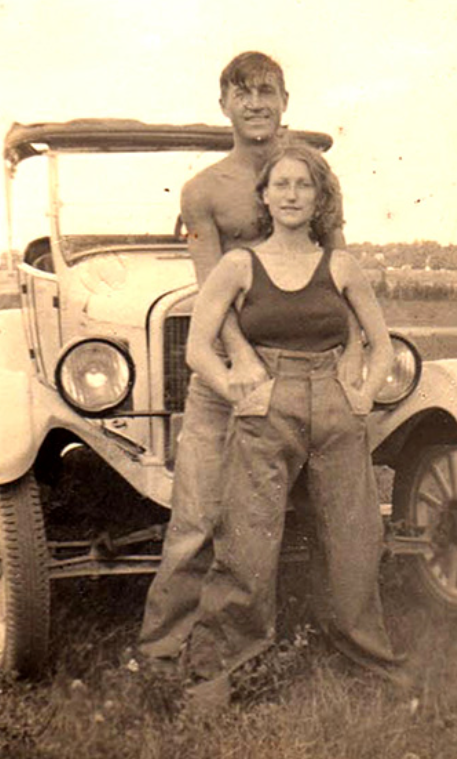
Paul Rogers and his wife Helen, photo by Tattoo Archive

Paul Rogers, photo by Tattoo Archive
The Norfolk Era: Working with Cap Coleman
The year 1945 marked a pivotal shift for Paul Rogers when he teamed up with the renowned August "Cap" Coleman in Norfolk. For Rogers, this collaboration was the fulfillment of a professional ambition; he viewed the invitation to work alongside such a titan of the craft as a monumental honor.
The move also brought significant financial prosperity. While his previous employment in the textile mills paid a peak of $42 for a full workweek, his tattooing income skyrocketed to between $150 and $200 weekly. However, not everything was easy: Norfolk prohibited tattooing in 1950, and Rogers utilized his established reputation to launch a new venture in Virginia with Lathan Connelly, and this partnership eventually expanded into North Carolina.
Rogers then pivoted toward the industrial side of the trade, co-founding the mail-order firm Spaulding & Rogers with Huck Spaulding, a business that mirrored the very catalogs through which Rogers had acquired his own first kit. Although their professional relationship lasted until 1961, Rogers’ direct participation in the supply company's daily operations fluctuated during those years. The Spaulding & Rogers still sells tattoo equipment and supplies until today.
One thing more we can say about those five years in Norfolk is that the "Coleman-Rogers" influence solidified the rules of American traditional tattoos in Berlin and beyond:
- Bold, consistent outlines that survive the test of time.
- Heavy black shading (the "black is the backbone" philosophy).
- Saturated, limited color palettes that age with dignity.
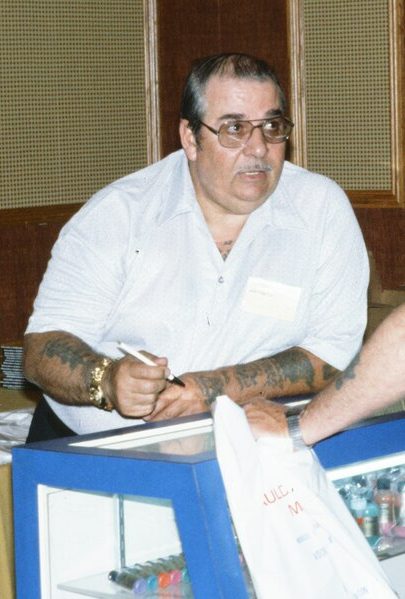
Huck Spaulding at a Tattoo Convention, 1979, Denver - Photo by Manfred Kohrs
The Iron Factory: Revolutionizing the Tattoo Machine
Rogers’ career was defined by a constant pursuit of technical perfection, leading him to traverse the country to study under various masters. Between 1961 and 1963, he worked in New Jersey alongside Sailor Eddie Evans, before relocating to Florida to collaborate with Bill Williamson.
Unfortunately, his time with Williamson was unexpectedly cut short by the latter’s passing only a year later, at which point Rogers assumed control of the studio.
Roger’s travels continued, including a brief 1970 return to New Jersey to work with Ernie Carafa. Later that same year, Rogers and his wife, Helen, decided to end their itinerant lifestyle and retire to Florida. And that is where the title of this section comes to life: they lived in a mobile home that served as the base for the "Iron Factory", a small 12x12 tin shed where he built what are arguably the best-running tattoo machines in history.
Drawing on decades of experience and the lessons learned from the industry’s greatest practitioners, Rogers engineered tools of remarkable quality. His innovations, such as the cut-back liner and his specific frame geometries (like the famous J-Frame), allowed artists to pack color and pull lines with a speed and consistency never seen before.
The Iron Factory became a site of pilgrimage. The legacy of Rogers' "Irons" is evidenced by their presence in the hands of the industry’s most elite artists, including figures like Don Ed Hardy, Kari Barba, Bob Roberts, and others. Today, these machines are highly coveted by collectors and professionals alike, often fetching premium prices on the market. Beyond his mechanical contributions, Rogers is remembered as a transformative figure who shaped the culture of the craft. He was a dedicated mentor who helped develop the skills of numerous apprentices and was notably one of the earliest proponents for the inclusion and advancement of women within the tattooing community.
This spirit of mentorship and technical transparency is a core value Mariano maintains at Traditional Tattoo Berlin, where the tools of the trade are treated with the same reverence Rogers practiced.
The tattoo machines created by Paul Rogers, photo by Tattoo Archive.
The Iron Factory - Paul Rogers holding its sign, photo by Tattoo Archive.
The tattoo machines created by Paul Rogers, photo by Tattoo Archive.
The Iron Factory - Paul Rogers working inside, photo by Tattoo Archive.
Cultural Authority and Legacy
Paul Rogers was more than just a technician; he was a cultural architect. He was one of the first major figures in tattooing to openly advocate for and mentor female tattooists, a radical stance for his time. His kindness, loyalty to the art, and work ethic made him a "friend to all" in an industry that was often secretive and territorial.
When he passed away in 1990 at the age of 84, he donated his massive collection of flash, machines, and correspondence to the Tattoo Archive. This led to the formation of the Paul Rogers Tattoo Research Center (PRTRC), a non-profit dedicated to preserving the history of this craft.
Why This Matters for Your Next Tattoo in Berlin
When you look for a traditional tattoo artist in Berlin, you are looking for a link to this specific lineage. You aren't just getting a drawing; you are participating in a century-old tradition of "work that lasts."
At Traditional Tattoo Berlin, Mariano's approach is a direct reflection of the Paul Rogers standard:
- The Technical Standard: Just as Rogers obsessively tuned his "Irons," Mariano focuses on the technical execution that ensures traditional tattoos age well.
- The Aesthetic Standard: Using iconic motifs like eagles, panthers, and roses that Rogers helped popularize, while maintaining the bold line philosophy that defines the style.
- The Professional Standard: An easy and straight forward appointment system, disciplined environment that respects the client and the history of the art, moving away from the "carnival" chaos of the past toward a focused, unique and unforgettable experience for first timers or tattoo collectors.
Conclusion: The Father of the Unfailing Line
Paul Rogers once said that he decided to learn to tattoo to "travel with the carnival and work on the sideshow," but he ended up building the framework for an entire global industry. His life, from the cotton mills to the Hall of Fame, is a testament to the power of the classic traditional tattoo.
For those in Berlin looking to carry a piece of this history, Mariano offers a space where the "Paul Rogers standard" is the baseline. Whether you are interested in traditional flash tattoos or a custom American traditional sleeve, the goal remains the same: a tattoo that looks as good in forty years as it does the day you leave the shop.
Ready to start your own piece of history?
Explore the work page to see how this heritage is applied today, or visit the FAQ to read more about how the booking and tattoo session works. And if you're sure about your next tattoo, just send a message via the booking form for a consultation or an appointment.
Sources utilized for this historical deep-dive include the Tattoo Archive, Mariano’s personal book collection, and knowledge and Paul Rogers Tattoo Research Center.
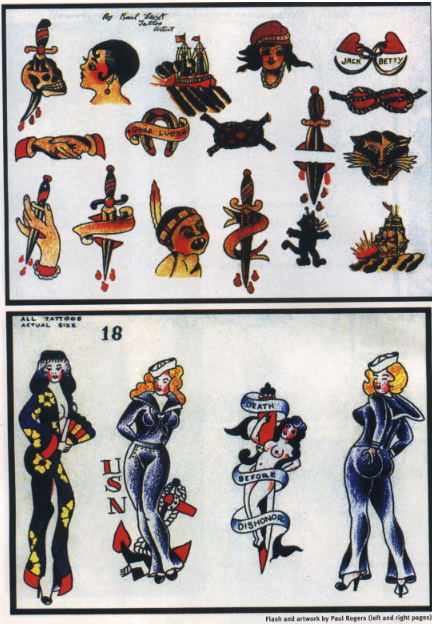
Paul Rogers flash designs, photo by Tattoo Archive
Paul Rogers, Spaulding and other legends, photo by Tattoo Archive
Related Reading:
- Don Ed Hardy: The father of the Tattoo Renaissance
- About Mariano and the traditional tattooing in Berlin
- Getting a full sleeve in Traditional tattoo style
- American Tattoos in Berlin: A History
- Tattoo History: The Crawling Panther design
- The Pharaoh’s Horses Tattoo: History and Technical Mastery of a Traditional Masterpiece