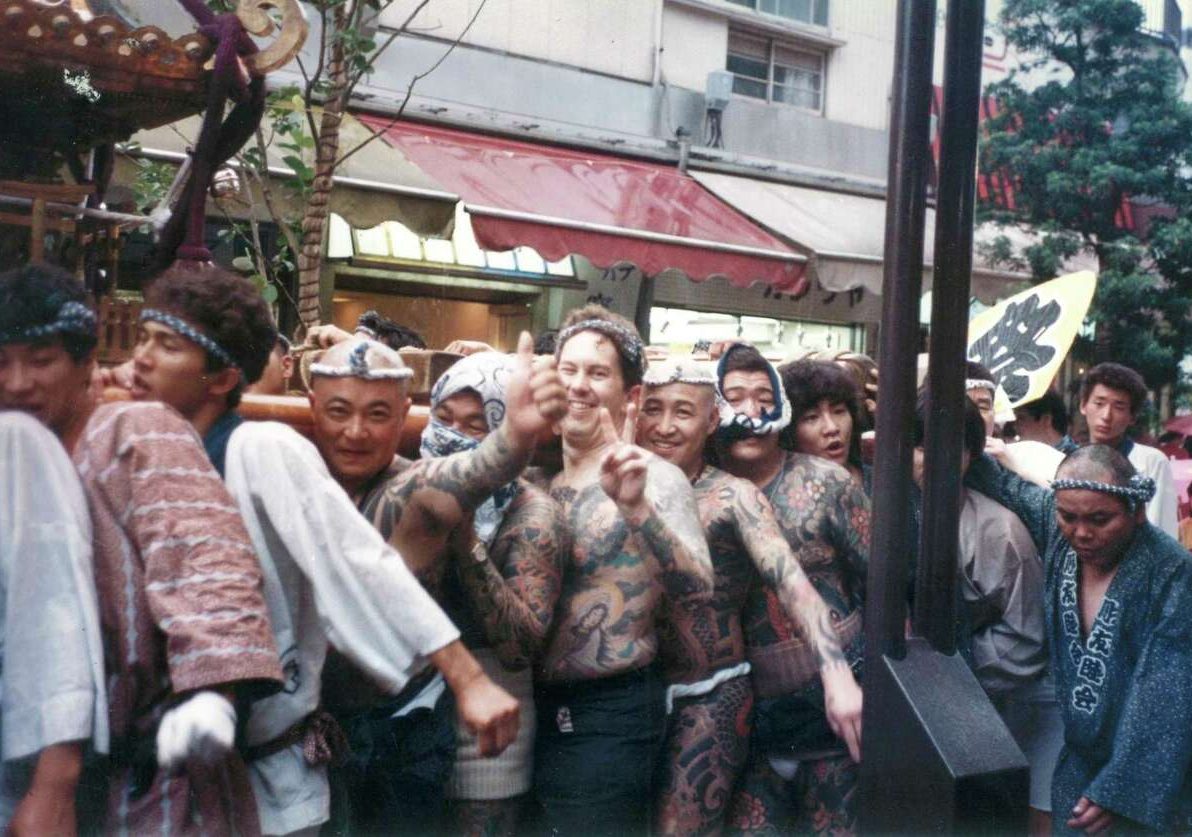
Don Ed Hardy: The Father of the Tattoo Renaissance
Don Ed Hardy is the single most influential figure in modern tattoo history, responsible for transforming a stigmatized maritime folk art into a globally recognized fine art form. His legacy is defined by the "Tattoo Renaissance", a movement that introduced custom design, Japanese technical precision, and academic rigor to the craft. For anyone seeking a traditional tattoo in Berlin, Ed Hardy’s life provides the blueprint for the custom, high-detail heritage style found at Traditional Tattoo Berlin.
To walk into a modern studio today and expect a custom drawing is to enjoy a luxury that didn't exist before Don Ed Hardy. Before the branding, the fashion, and the global fame, there was a kid in Southern California who looked at the rough, bold lines of the Long Beach Pike and saw a window into another world. To understand the American traditional tattoos in Berlin that Mariano creates today, we must trace the steps of the man who refused a Yale scholarship to pick up a tattoo machine.
The Eyeliner Artist: Don Ed Hardy between 1945–1956
Born in Des Moines, Iowa, in 1945, Donald Edward Talbott Hardy was a child of the post-war shift. While his father served in World War II, his mother moved to Corona del Mar, California, which placed young Ed in the ideal environment to witness the birth of modern American subculture.
By 1955, at just ten years old, Hardy was already mesmerized by the ink he saw on military personnel returning from overseas. While other kids were playing baseball, Hardy was setting up shop. He used eyeliner for black outlines and wet colored pencils for saturation, "tattooing" the neighborhood kids for pennies. He even enforced a "parents' permission" rule for his ten-year-old "clients." This wasn't just play; it was the early manifestation of an artist who understood that tattooing was a serious, disciplined ritual.
Hardy “tattooing” a neighborhood friend as a kid, around the 50s.
Hardy actually tattooing a client around the 70s
Bert Grimm and the Long Beach Pike
The real education began at the Long Beach Pike. In the mid-1950s, "The Pike" was a gritty, pre-theme-park amusement pier that smelled of salt air and machine oil. It was there that Hardy met Bert Grimm, a man he would later describe as the quintessential "tattoo hustler man". Grimm was a storyteller and a self-promoter (some might say bull-shitter, but not us at Traditional Tattoo Berlin), but above all, he was a master of the Americana style: strong, bold, unforgettable.
Watching Grimm work solidified Hardy’s obsession. He wasn't just looking at the tattoo or flash designs; he was looking at the history. By 1958, a junior high school writing assignment led him to the library to devour George Burchett’s Memoirs of a Tattooist. While his peers were studying standard history, Hardy was mapping the lineage of the needle, ink, tattooing, and more.
Tattoo shop from Bert Grimm, Long Beach
The Academic Crossroads: 1961–1967
Hardy’s path could have easily led him away from tattooing. In 1961, an art teacher named Shirley Rice pushed him to look beyond the "surf art" of his youth and introduced him to Picasso and art history. This exposure fired up a liberal, sophisticated sensibility that would eventually allow him to elevate tattooing into the realm of fine art.
By 1963, he arrived in San Francisco to study printmaking at the Art Institute. The city was a revelation to Ed. Victorian architecture, ethnic diversity, and a "transgressive" energy that felt like Mars compared to normal-life Orange County. Hardy was hooked!
In 1966, he was offered a full-ride scholarship to Yale for a Master’s degree. For any aspiring artist, this was the "made man" moment. Hardy turned it down, believe it or not. He did it because he chose the "professional suicide" of tattooing.
A airbrushed t-shirt Ed Hardy did when he was a teenager
Ed Hardy inside a tattoo shop, circa 1970s
Ed Hardy with Bert Grimm
Ed Hardy and Bert Grimm tattooing
Phil Sparrow and the Japanese Shock Wave
The catalyst for this choice was Phil Sparrow. Phil Sparrow or Phil Andros, if you may, was the real name of Samuel Morris Steward, an American tattoo artist and pornographer.
Hardy tracked him down in Berkeley and, in exchange for art school insights, Sparrow showed Hardy a book on Japanese tattooing. The impact was immediate and tectonic.
Until that moment, American tattooing was mostly "eagles and anchors" as small, disconnected pieces. But the Japanese imagery showed Hardy that the body could be a cohesive canvas; it could be a unit of designs and motifs forming one beautiful piece of art on skin. He saw the potential for tattoos to be "spectacularly transgressive" art. He convinced Sparrow to teach him the basics, pulling his first tattoo (a small test piece on his own ankle), and the Tattoo Renaissance was unofficially born.
The Nomadic Years: Ed Talbott and the Vietnam Surge
Hardy knew that to become a master, he needed to leave San Francisco and refine his craft where his mistakes wouldn't haunt him. In 1968, under the pseudonym "Ed Talbott", he moved his family to Vancouver, British Columbia, to open Dragon Tattoo.
But the pull of the heritage style brought him back to California. By 1969, he was tattooing in San Diego under Doc Webb. It was the height of the Vietnam War, and the port was flooded with thousands of soldiers and sailors every week. This was "street shop" tattooing at its most intense: high volume, high pressure, and the absolute necessity for bold lines that could be applied quickly and last forever.
Phil Sparrow Portrait.
Dragon Tattoo Shop in British Columbia from Ed Hardy
The Correspondence with Sailor Jerry
It was during this time that Hardy began writing to Norman "Sailor Jerry" Collins in Honolulu. This correspondence is the most important exchange in tattoo history. They shared photos, technical secrets, and a mutual obsession with Japanese craft.
Through Jerry, Hardy was introduced to the work of Japanese masters like Horihide (Kazuo Oguri). Jerry was the gateway, providing the bridge between the Americana Hardy grew up with and the Eastern mastery he craved. In 1973, shortly after meeting his life partner Francesca Passalacqua, Hardy traveled to Gifu, Japan, to study with Horihide firsthand.
a Sailor Jerry tattoo machine owned by Ed hardy rebuilt by Paul Rogers
Sailor Jerry Collins tattooing Jim Orr with the sliding door track machine, c.1960.
Ed Hardy and Franscesca Passalacqua being a great couple
Realistic Tattoo: The Birth of the Custom Shop
When Hardy returned to San Francisco in 1974, he did something radical. He opened Realistic Tattoo.
It was the first shop in the United States dedicated to large-scale, custom work. There was no neon sign, the door was almost always locked, and you couldn’t see flash on the walls. The slogan was "Wear Your Dreams".
In this moment, Hardy was no longer a "tattooer" in the traditional sense; he was an artist collaborating with clients to create bespoke masterpieces. This is the foundation of the traditional tattoo artist in Berlin model that Mariano uses today: an environment of focus, discipline, and artistic intent.
Ed Hardy tattooing a client.
Ed Hardy tattooing a back piece
The Mission District and the Chicano Spark
In 1977, after attending the first Reno Tattoo Convention, Hardy discovered the Chicano-style tattoos of Jack Rudy and Charlie Cartwright. The fine-line, black-and-grey work of East LA "pole-axed" him. He saw a new way of perceiving art on the skin.
He opened the first Tattoo City location in the Mission District to bring this style to San Francisco. Tragically, the shop was lost to a fire in 1978, a devastating blow that destroyed gear and historic flash. But the resilience of the craft stayed with him.
Tattoo city after it caught fire around 1978
A flyer advertising Tattoo City on Mission Street, 1977.
Tattootime and the Scholarly Shift
By 1982, Hardy realized that for tattooing to be taken seriously, it needed its own history books. Alongside Francesca and Leo Zulueta, he published the first issue of Tattootime. This periodical treated tattooing with the same academic rigor as art history journals.
It introduced concepts like "New Tribalism" to the world and documented the history that would have otherwise been lost. Between 1982 and 2019, Hardy and Francesca published over 30 books, ensuring that the classic traditional tattoo would be preserved for future generations.
The Queen Mary and the Global Community
In 1982, Hardy also hosted the Queen Mary Tattoo Expo in Long Beach. It wasn't just a convention; it was a summit. He brought in UCLA art historians to give lectures on symbolism alongside tattoo legends. He was successfully forcing the "skeptical world" to acknowledge the power and magic of the craft.
This period saw him traveling back to Japan regularly to work with Horiyoshi III (Yoshihito Nakano), the most renowned master of the era. Hardy’s style became a "California Dragon", a pop-style infusion of American energy into Asian imagery.
Ed Hardy and Horiyoshi III
Flyer from the Queen Mary Tattoo Expo in Long Beach
Honolulu and the Return to Painting
By 1986, the intensity of the tattoo world and Francesca’s health led them to Honolulu. Here, Hardy "woke up with a brush in his hand." He reconnected with painting and printmaking, mediums he had neglected for twenty years while focusing on the needle.
This sabbatical allowed him to develop the "larger, looser" style that would later define his seminal work, 2,000 Dragons—a 2,000-square-foot canvas painted in the year 2000 to honor the Asian zodiac.
Tattoo City Reopens and the Fashion Explosion
In 1991, at the urging of his employee Freddy Corbin, Hardy reopened Tattoo City on Columbus Avenue in San Francisco. It became a historic landmark of the city's culture.
Then came 2004, and Hardy licensed his fashion designs. Suddenly, his name was on every street corner, every trucker hat, and every energy drink. While the brand became a global phenomenon, Hardy himself was often exploited, leading to years of legal battles to regain control of his master license. He once remarked that the brand "harnessed the psychic power of the tattoo," even if the public didn't always understand the history behind the images.
Ed Hardy's 2000 Dragon
A shop of the fashion brand featuring Ed Hardy's name and designs
Retirement and the de Young Legacy
Don Ed Hardy retired from tattooing in 2008, finishing his final piece (a dragon, of course) on Mary Joy Scott, one of the resident tattoo artists from Tattoo City. He saved his remaining energy for his personal art, leading to a massive career retrospective at San Francisco’s de Young Museum in 2019. The show, Deeper than Skin, proved once and for all that his mission was accomplished: tattooing was now a fine art.
The Final Chapter: Honor and Memory
In 2023, following a fall and a broken femur, Ed Hardy was diagnosed with Alzheimer’s. He now resides in a memory care facility, where he still draws and works on puzzles with Francesca. His son Doug Hardy and his wife visit him daily, maintaining the bond that has fueled his storied career. Doug Hardy used to tattoo with his father at Tattoo City, and since the shop closed down in 2024, Doug has been tattooing in a new location.
For the traditional tattoo booking in Berlin, the story of Ed Hardy is not just a history lesson. It is a reminder that every bold line pulled by an artist like Mariano is a continuation of Hardy’s "Tattoo Renaissance." We are all "wearing our dreams" because one man decided that a tattoo could be a masterpiece.
Protect the Legacy & Wear the Tradition. Whether you are looking for a traditional flash tattoo or a large-scale custom project, you are participating in the history Hardy built. Browse the work page to see how these principles are applied today, or reach out via our contact page to start your own piece of history.
Related Reading:
- About Mariano and the traditional tattooing in Berlin
- Getting a full sleeve in Traditional tattoo style
- Tattoo history: Paul Rogers, the father of American tattooing
- American Tattoos in Berlin: A History
- Tattoo History: The Crawling Panther design
- The Pharaoh’s Horses Tattoo: History and Technical Mastery of a Traditional Masterpiece