The Crawling Panther Tattoo: History and Evolution of a Traditional Icon
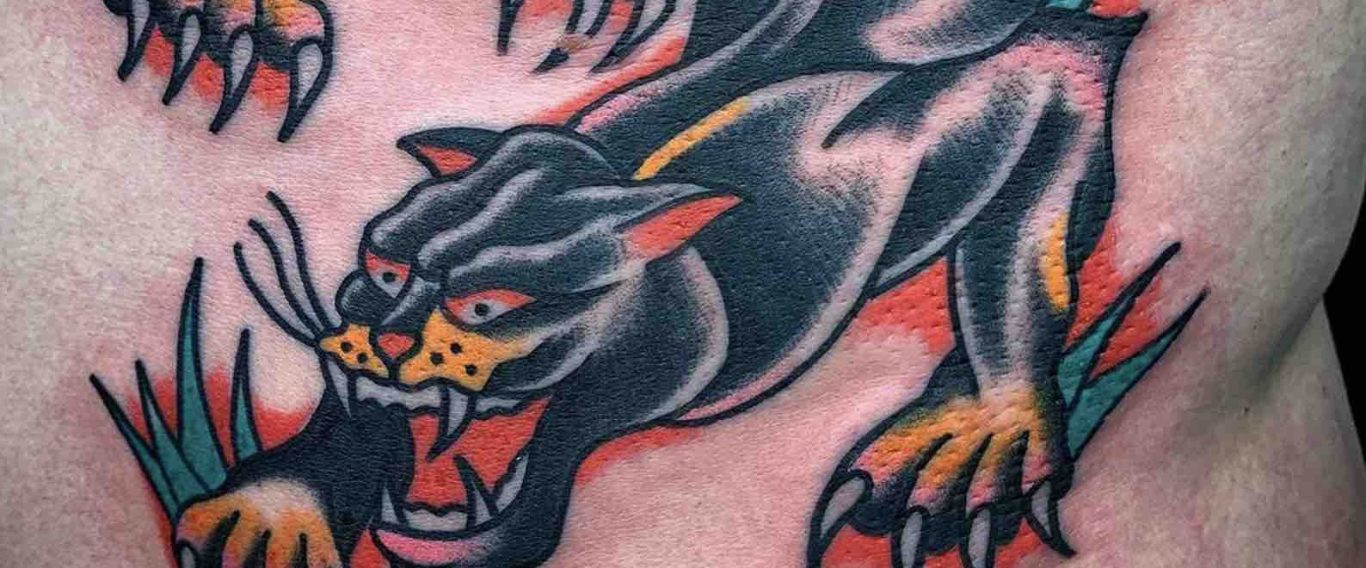
The Crawling Panther tattoo is a fundamental motif in American traditional tattooing, defined by its tensed, predatory posture and heavy black saturation. While the visual inspiration traces back to Marie Schubert’s 1934 book Minute Myths and Legends, the design was refined as tattoo flash by Prof. William Grimshaw in the 1940s, representing resilience, stealth, and technical power.
In the lexicon of American traditional tattoos, few images command as much respect as the Crawling Panther tattoo. It is more than a simple animal portrait; it is a structural masterpiece that defined how 20th-century tattooers approached human anatomy. To understand the history of this specific design is to understand the birth of modern electric tattooing and the technical shift toward the "Bold Will Hold" philosophy that defines every traditional tattoo artist.
The Marie Schubert Connection: 1934 and the Birth of a Blueprint
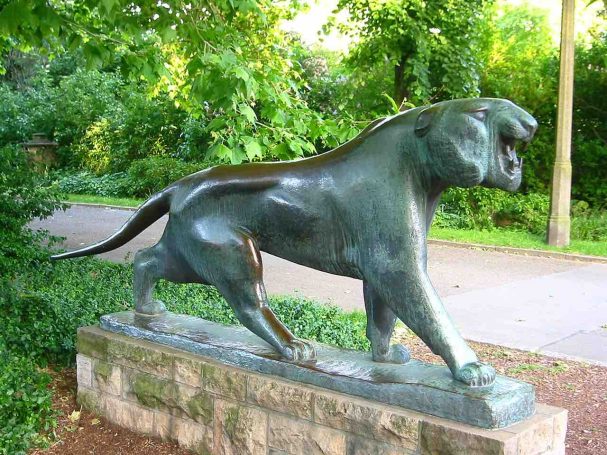
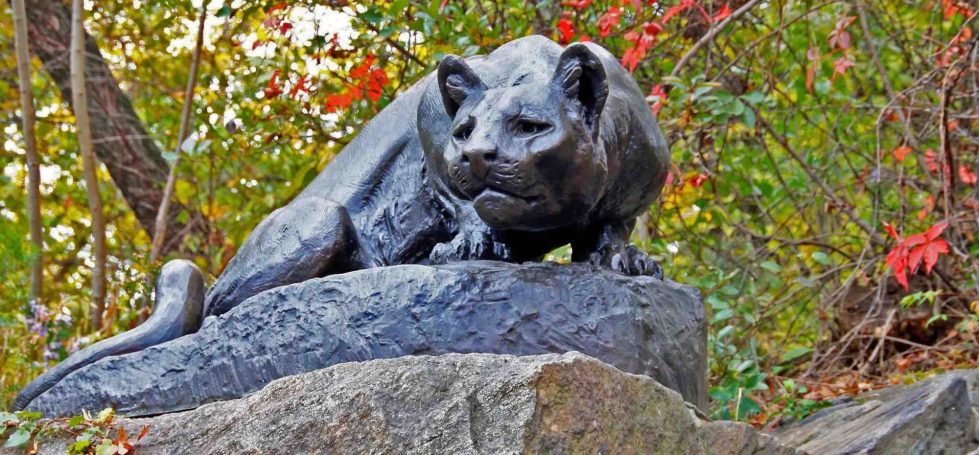
For over three millennia, the panther has endured as a symbol of power throughout human history. Its silhouette has graced everything from ancient Roman bronzes to the military uniforms of China’s Ming and Qing dynasties. Today, that legacy continues in places like Central Park in New York or Tierpark in Berlin, where dedicated sculptures stand guard in both parks. Long before the internet offered a digital library of flash, tattoo artists were resourceful scouts, hunting for inspiration in books, cigarette cards, and vintage advertisements. It was through this analog search that one of tattooing's most iconic motifs, the crawling panther, was born.
For decades, the specific origin of the Crawling Panther tattoo was shrouded in the "oral tradition" of tattoo shops.
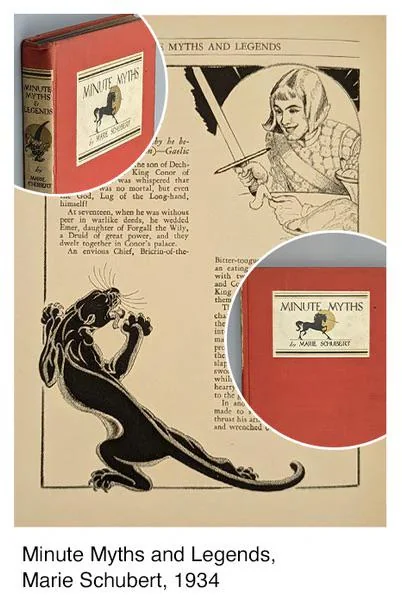
However, archival research has identified the definitive visual source: a children's book titled Minute Myths and Legends, written and illustrated by Marie Schubert in 1934.
Schubert’s illustration was not intended for skin; it was a depiction of a prowling black cat accompanying a myth. However, its aesthetic properties (the arched back, the extended front paw, and the tensed hindquarters) were a revelation for the tattooers of the mid-Atlantic coast. The illustration provided a perfect balance of negative space and form, which allowed it to be translated into the high-contrast medium of early electric tattooing. It served as a bridge between 19th-century folk illustration and the emerging 20th-century tattoo flash industry.
The Flash Pioneer: Prof. William Grimshaw and the Norfolk Influence
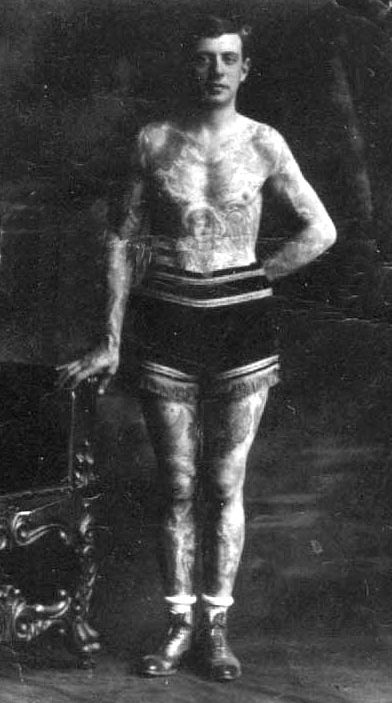
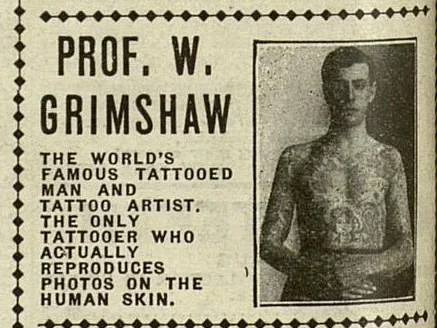
While the image existed in print by 1934, it required a master of the craft to translate it into a repeatable, high-impact Crawling Panther tattoo. That credit belongs largely to Prof. William Grimshaw, a legendary figure based in Norfolk, Virginia.
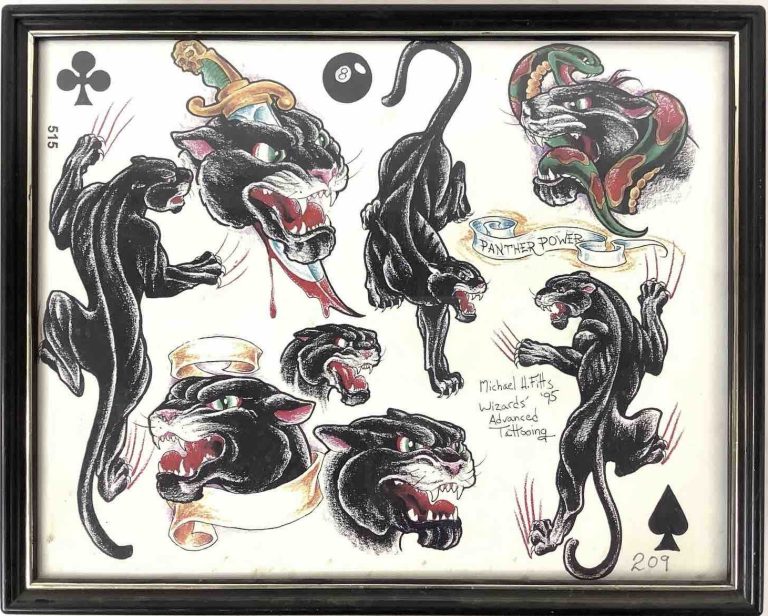
During the 1940s, Norfolk was a massive hub for the U.S. Navy. Grimshaw recognized that Schubert’s panther could be adapted into a design that was both fast to execute—essential for the "speed tattooing" required in a bustling naval port—and visually striking from across a room. He refined the silhouette, added the signature "snarl," and introduced the red and yellow highlights in the face and claws. Grimshaw’s version of the Crawling Panther tattoo became the blueprint that would later be picked up and further refined by icons like Sailor Jerry Collins and Bert Grimm, eventually becoming a staple of old school tattoos in Berlin like the Pharaoh’s Horses tattoo.
Anatomical Engineering: The "V-Shape" Logic
What makes the Crawling Panther tattoo a "Masterpiece" motif is not just its look, but its utility. It was one of the first designs specifically engineered to work with the natural geometry of the human body. This is a crucial concept for anyone studying classic tattoo designs.
The Flow of the Forearm and Calf
The human limb is not a flat canvas; it is a series of "V" shapes and cylinders.
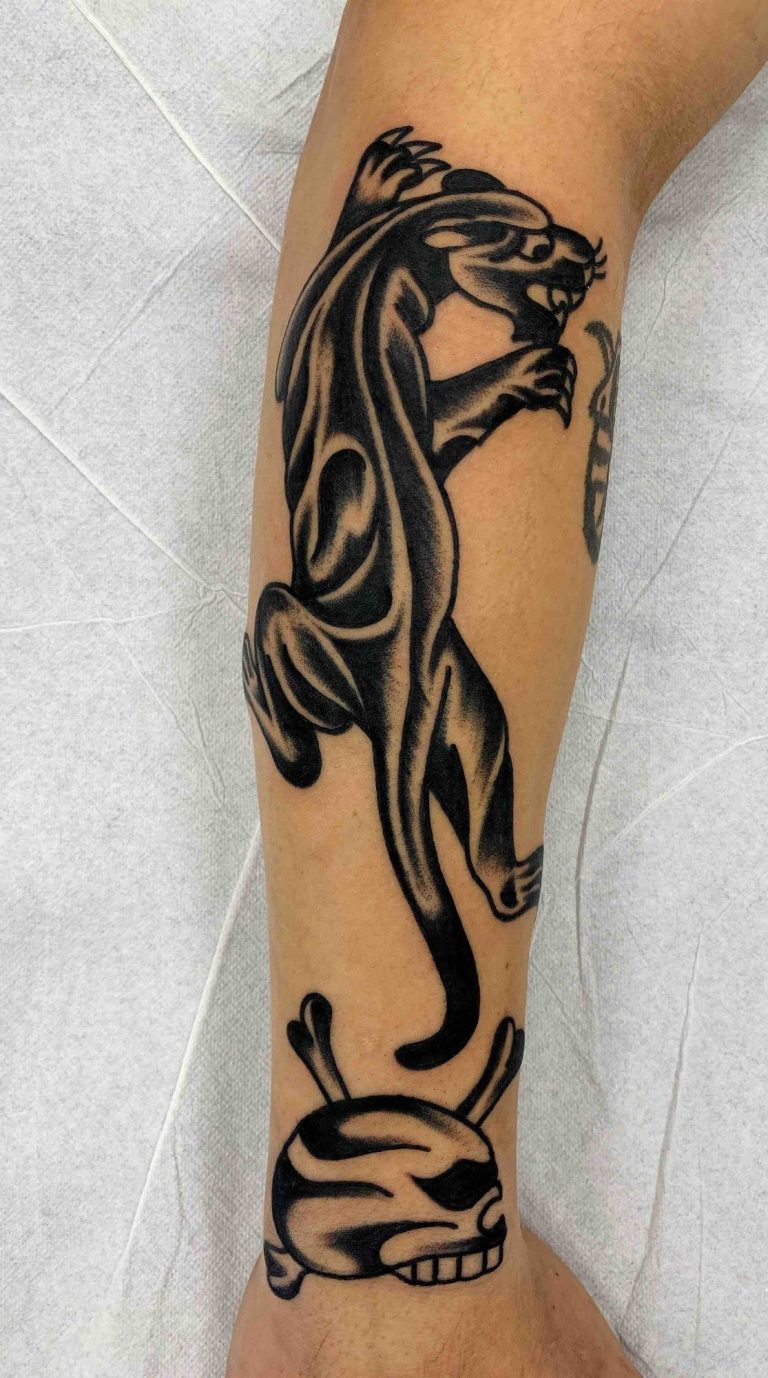
The Crawling Panther tattoo posture (the downward crawl with the front paws reaching) is designed to follow the taper of the forearm or the curve of the calf. When placed correctly, the panther appears to be physically "gripping" the muscle. This concept of "Anatomical Flow" is a primary reason why bold line tattoos look better as they age. They move with the wearer rather than fighting the body's natural lines.
The "Skin Break" Philosophy
In the traditional school, a solid black Crawling Panther tattoo is considered a technical error. A true heritage tattoo execution requires "skin breaks"—strips of un-tattooed skin that represent the highlights of the panther’s fur. These breaks provide the contrast necessary to prevent the tattoo from becoming a flat, illegible black blob over time. Without these highlights, the design loses its three-dimensional power and its ability to "read" correctly from a distance.
Variations and Symbolic Evolution
While the Grimshaw blueprint is the standard, the Crawling Panther tattoo has evolved into several high-intent variations:
- The Snake vs. Panther: Often seen on back pieces or chests, this represents the struggle between wisdom (the serpent) and raw, predatory power (the panther). It is a narrative companion to the Battle Royale designs.
- The Snarling Head: Sometimes the panther is reduced to just the head, emphasizing the ferocity and the "protection" aspect of the motif.
- The Panther with Dagger: Symbolizing the duality of life and death, this variation often incorporates elements from traditional sleeve tattoo compositions.
The Legacy of the Crawling Panther Tattoo in Berlin
In the modern tattoo landscape of Berlin, the Crawling Panther tattoo remains a definitive choice for serious collectors. It is a design that ignores the "noise" of modern trends and focuses entirely on the core pillars of the craft: the perfect outline, the solid shadow, and the respect for history.
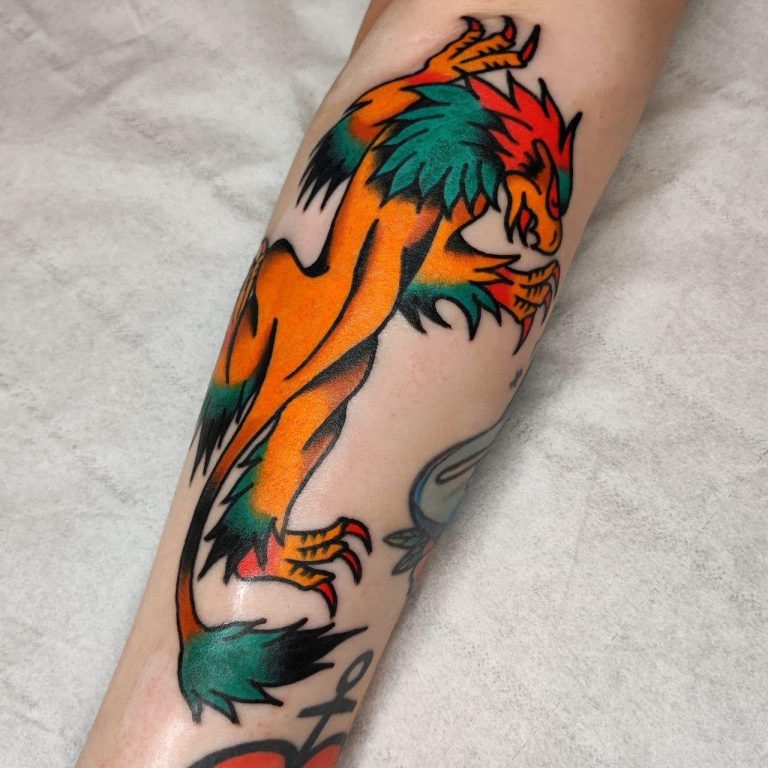
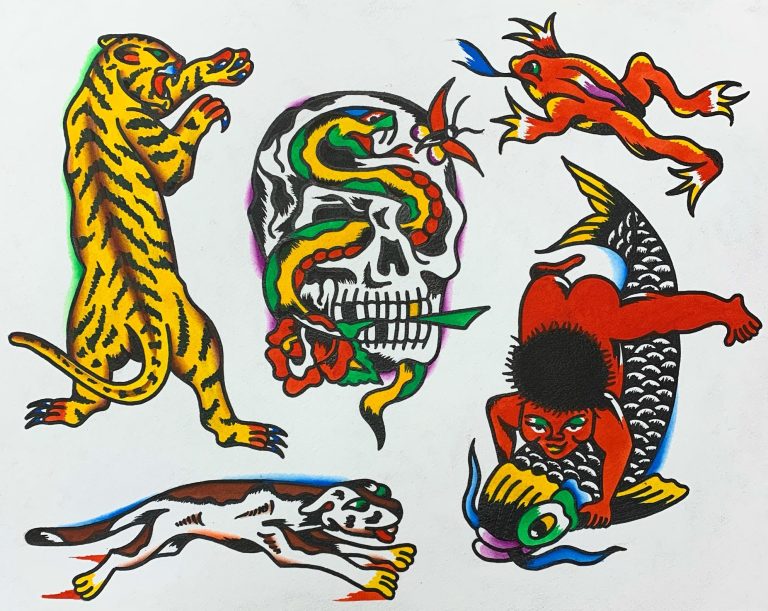
Whether it is placed as a standalone "filler" or as the anchor of a larger project, the Crawling Panther continues to be the most resilient symbol of the American traditional heritage. It is a reminder that in the world of tattooing, some things don't need to change to remain powerful. Traditional tattoo artists often explore versions of this classic design with their own artistic takes like the examples below.
Traditional Tattooing in Berlin
In case you're in Berlin and you're looking for a traditional tattoo artist to get your crawling panther tattoo, if you want to use the original name, Mariano's books are always open. And to book your appointment or consultation, click on the button below