The Pharaoh’s Horses Tattoo: History and Technical Mastery of a Traditional Masterpiece
The Pharaoh’s Horses tattoo is a monumental motif in American traditional tattooing, depicting three equine heads in a dynamic, circular arrangement. Based on an 1848 painting by John Frederick Herring Sr., the design is considered one of the "Big Three" challenge pieces of the craft, symbolizing untamed power, pride, and the technical pinnacle of traditional shading and composition.
In the world of American traditional tattoos, the Pharaoh’s Horses tattoo holds a status of distinct prestige. Alongside the Crawling Panther and the Battle Royale, it represents the upper echelon of traditional flash. To understand the history of this motif is to understand how 19th-century academic art was repurposed by the working-class docks of the early 20th century to create symbols of resilience and aesthetic strength.
The John Frederick Herring Sr. Connection: 1848 and the Victorian Era
The visual origin of the Pharaoh’s Horses tattoo is remarkably precise. It was originally an oil painting titled "Pharaoh’s Chariot Horses", completed in 1848 by the celebrated British artist John Frederick Herring Sr. Herring was a master of equine portraiture, and this specific piece, depicting three stallions in various states of wild emotion, became a Victorian-era sensation.
The painting was intended to represent the horses of the Egyptian Pharaoh pursuing the Israelites across the Red Sea (Exodus), but as the image was reproduced in millions of lithographs and prints, its religious context softened into a broader representation of "The Untamed Spirit."
By the time early tattoo flash pioneers like Percy Waters and Milton Zeis began adapting it for skin, the Pharaoh’s Horses tattoo had become a secular badge of pride and power.
The Birth and Evolution of the Pharaoh's Horses Tattoo Design
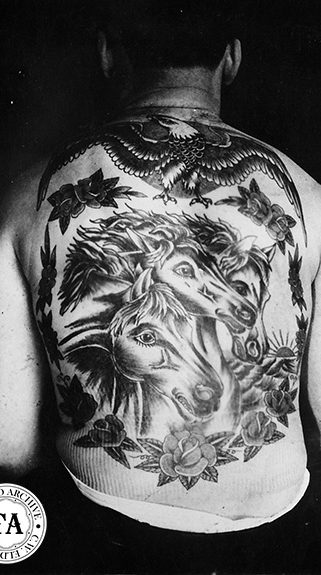
The lineage of the Pharaoh’s Horses in tattoo culture begins in the early 20th century with the pioneer Gus Wagner. He is credited with the first recorded instance of the design: a full back piece featuring a mirrored rendition of the iconic trio, elegantly framed by floral arrangements and topped with a soaring eagle.
During the Great War, the design’s popularity surged alongside other enduring classics. As legendary artist Leonard "Stoney" St Clair noted in his interviews, World War I was a golden era for iconic flash like the "Rose of No-Man's Land". It was Charlie Wagner, a titan of the industry, who helped solidify these motifs, specifically adapting the Pharaoh’s Horses for the medium of skin. These traditional designs remained the industry standard until the 1940s, when the "biker" aesthetic introduced a darker shift toward reapers, cobras, and skulls.
Charlie Wagner’s influence on the craft cannot be overstated. Operating in New York City from the early 1900s until 1953, he began his journey as an apprentice to Samuel O’Reilly, the man who patented the first electric tattoo machine. Wagner didn't just inherit this legacy; he expanded it.
Working with his partner George F. Burchett, Wagner refined O’Reilly’s original blueprints to create a machine that was faster, more precise, and significantly more efficient. This technical leap acted as a revolution for the industry, providing artists with the mechanical precision necessary to execute the intricate, high-detail compositions that define the Pharaoh’s Horses.
Beyond his mechanical contributions, Wagner was celebrated for a signature aesthetic. His work was defined by saturated colors and heavy, bold linework, often celebrating patriotic Americana through imagery of eagles, flags, and military heraldry, a style that remains the bedrock of traditional tattooing today.
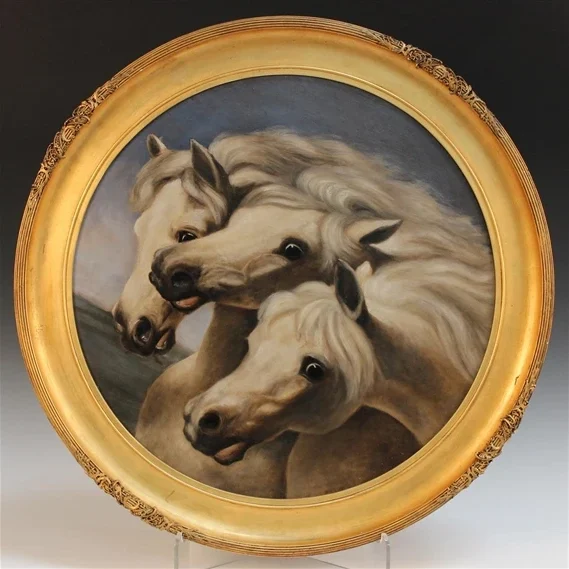
The original Pharaoh's Horses called "Pharaoh’s Chariot Horses" by John Frederick Herring Sr.

Maud Stevens Wagner, America's first known female tattoo artist, and Gus Wagner, American tattoo artist at work (circa 1910)
The "Challenge Piece": A Test of Traditional Craft
In the early-to-mid 20th century, the Pharaoh’s Horses tattoo was a "Challenge Piece." It wasn't just a design you picked from a wall; it was a design an artist used to prove they had mastered the technical requirements of the medium.
Circular Symmetry and Anatomical Flow
Unlike the Crawling Panther tattoo, which follows a "V-shape" logic for limbs, the Pharaoh’s Horses tattoo is designed with circular symmetry. This makes it the premier choice for the center of a chest or the focal point of a back piece. The three heads must be balanced perfectly so that no single horse dominates the composition, ensuring that bold line tattoos look cohesive from any angle.
The Mastery of Shading
The technical difficulty of this design lies in the shading. To distinguish three separate horse heads within a compact circle, the artist must use varying levels of contrast. Each horse requires specific "skin breaks" and high-impact highlights to suggest the rippling of muscles and the sheen of a coat. If the shading is too heavy, the horses merge into a dark mass; if too light, the design lacks the "toughness" expected of old school tattoos.
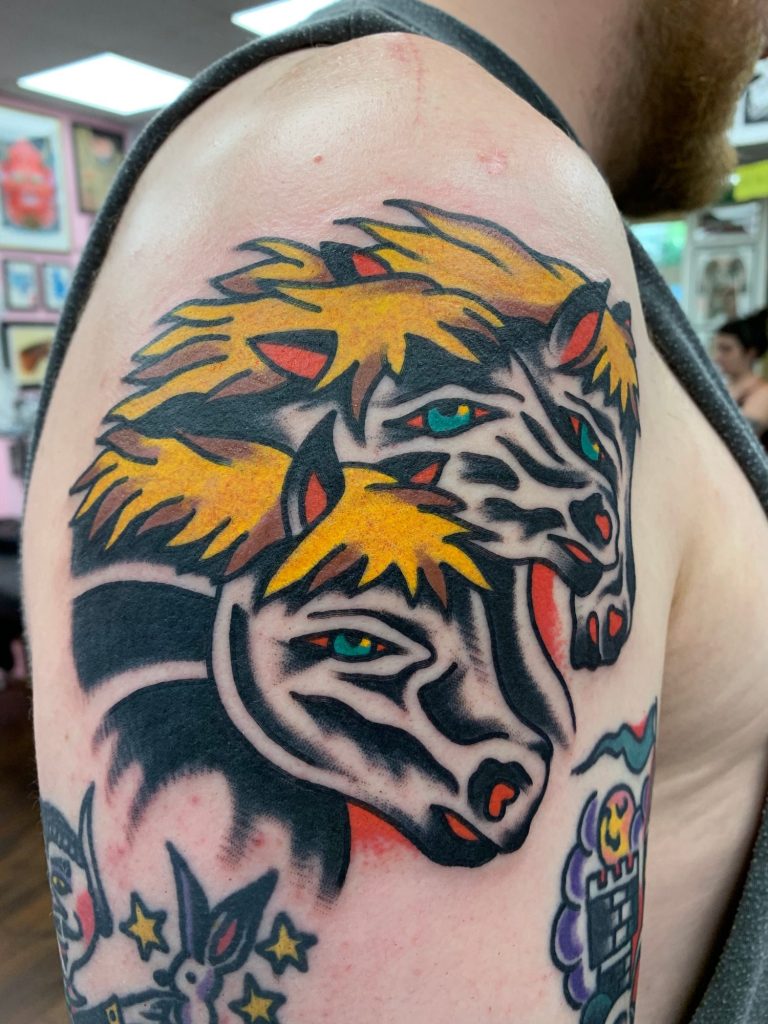
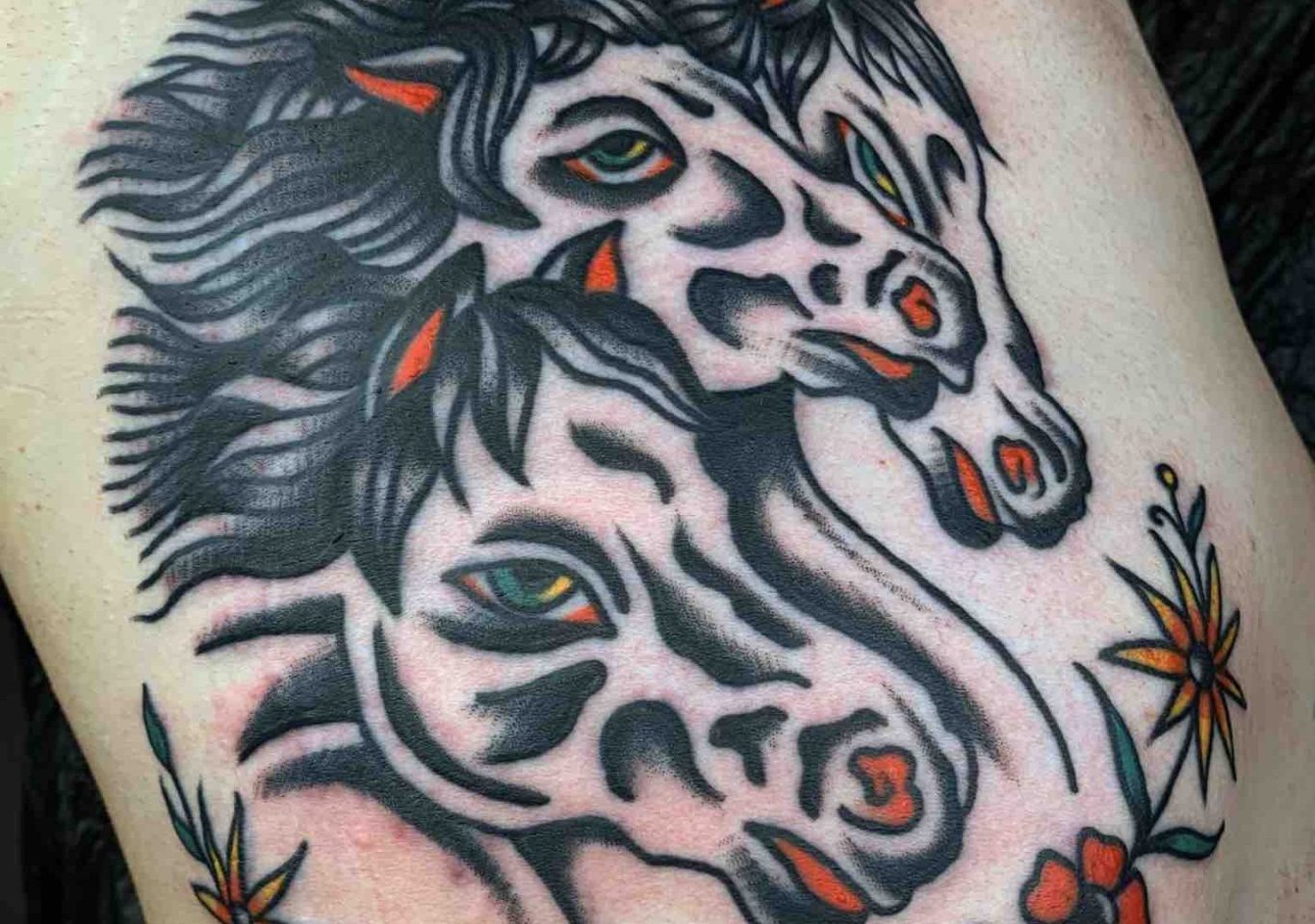
Pharaoh's Horses Tattoo (and known by the other name "The 3 horse head tattoo") done by traditional tattoo artist from Berlin, Mariano
Why This Design Still Matters in Berlin
In the modern traditional tattoo scene in Berlin, the Pharaoh’s Horses tattoo serves as a counterpoint to the fleeting "illustrative" trends of social media. It is a design that demands time, commitment, and a master’s touch.
Berlin is a city that values the intersection of grit and high art, making it the perfect home for a motif that began in the galleries of London and ended up on the forearms of the world's most serious collectors. At its core, the design is a testament to the "Bold Will Hold" philosophy—a complex, beautiful, and aggressive piece of art built to last a lifetime.
For further exploration into the technical requirements of large-scale traditional work, refer to our detailed guides on Traditional Sleeve Tattoos or our FAQ.
Traditional Tattooing in Berlin
In case you're in Berlin and you're looking for a traditional tattoo artist to get your three horses tattoo or pharaoh’s horses tattoo, if you want to use the original name, Mariano's books are always open. And to book your appointment or consultation, click on the button below.